
The Reasons Travelling Makes Us Happy
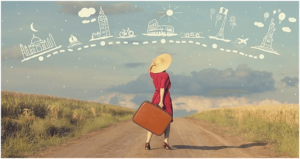
Everyone wants to be happy; so, why is it so difficult to find happiness? Happiness is not a possession or commodity but an emotion which cannot be purchased. However, some believe that purchasing products gives them happiness; others find happiness in food, sleep, and work/study and work out. So, what have these got to do with travelling? Well, travelling gives you unending happiness and boosts your spirit too. However, travelling gives us a higher sense of happiness which lasts for a much longer time than you buying any product would ever give you. Travelling helps us to be truly happy. So, that makes travelling so meaningful and what are the reasons behind travelling making us happy? Here are some reasons why we travel and how travelling makes us happy:- 1- Helps improve mental health– Sometimes working under pressure can get very strenuous as you might get depressed, frustrated and fed up with the job. How about taking a break by travelling? It would work as a stress buster! For, sometimes, we just want to break free from the work and stress, so travelling is not only about seeing new places. Rather it becomes necessary to take a break from a busy schedule of working life to a more relaxed one from time to time. According to a study in 2013, called the Stress in America survey by the American Psychological Association, concluded that going on vacations can actually reduce stress and the participants did not only feel better but could also handle stress better once they returned from the vacation. For, they had a break from the sources of stress, which is work. Additionally, travelling makes you healthier mentally as productivity and creativity improve, people get better sleep. 2- Peace-Many find peace in travelling because they feel it as a detoxification. Coming away from the monotonous life most of us have today, it helps some keep their sanity check by disconnecting from the rest of the world. The luxury of not having to rush, this allows the peace to be there in the first place. It feels like there’s no negativity in the world for that moment and by this one can live in the moment then. For example, sitting by a lake that can also give a person a sense of quietude. Now, imagine yourself sitting in front of this lake witnessing this marvelous sunset. 3- Architecture– How many of the Seven Wonders of the World have you seen yet? Many people travel to admire the beautiful architectural sights and to learn history. Travelling is a great way to learn history by looking at live examples of great emperors and kings, architects of ancient time who built outstanding monuments which many possibly can’t be rebuilt in spite of having the current technology. Some great ingenious structures/monuments of the world: the centuries old Ram Setu is the first man-made coral-reef bridge connecting India to Sri Lanka, Pyramids of Giza and The Sphinx of Giza in Egypt which has controversies and theories of being built by the help of extraterrestrial life, the Iron pillar of Delhi which is never rusts is in Delhi, India, Vijaya Vittala Temple in Hampi, Karnataka, India which has 56 musical pillars which produce musical tones when struck with a thumb, the Hanging Gardens of Babylon in Mesopotamia (Modern Iraq), and great statues such as the Buddhas of Bamiyan (standing Buddhas) carved from a mountain, Gommateshawara Bahubali monolithic 57 feet (17 metres) high located in Karnataka, India, and the Moray (Inca ruins) consisting several terraced circular depressions is still an ancient engineering mystery in Peru, South America. These tourism sights have their own mysteries hidden till now. This fascinates archaeologists and people interested in artwork research and others generally interested in the diversity of architectural beauty. 4- Travelling and education– Man has legs so that he can displace himself from one place to another either for food, shelter against the elements or for self-protection against hostile animals/predators for survival. However, his brain has another aspect that is curiosity to know the cause of daily things he sees. So, this has automatically developed in him a sense of exploration, expansion, to seek more than his familiar comfort zone/surroundings. Now, for the sake of expanding his knowledge, the sense of adaptability has quickly developed in his rapidly growing faculties. He experiences a joy of learning new skills through new activities. That is why travelling became another medium to see and learn other aspects of life which at every subsequent phase which in turn became a treasure house of his mental abilities. Additionally, it is said “Travelling is a part of education”. For, schooling is not the only education. So, travelling is a great way of learning about life. Many ancient scholars such Hiuen Tsang/Xuanzang and Fa Hien/Faxien was a Chinese Buddhist monks who travelled from China to India to learn about Buddhist scriptures, Marco Polo was an Italian merchant, explorer and writer who travelled through Asia along the Silk Route, Rahul Sankrityayan is called the Father of Indian Travelogue, Travel literature, spent forty-five years of his life on travels away from his home. Travelling also teaches us to be independent, adventurous, wander, to take risks because every locale, situation, site has different scenarios and outcomes turn out to be different almost for each person, even if they encounter the same occurrence. For instance, a group of four college students go hiking in the mountains and they encounter a wild bear. One of them might know to confront the situation. However, the others would most probably panic naturally because they are frightened and don’t have any idea how to deal with the wild bear. So, the one who knows can advise the others to follow his instructions to survive. That way the next time they would make prior preparations for a hike in the mountains. Moreover, travelling teaches us culture, religion, customs, languages, and way of lives of different human races we come across and respect them wholeheartedly. Therefore,